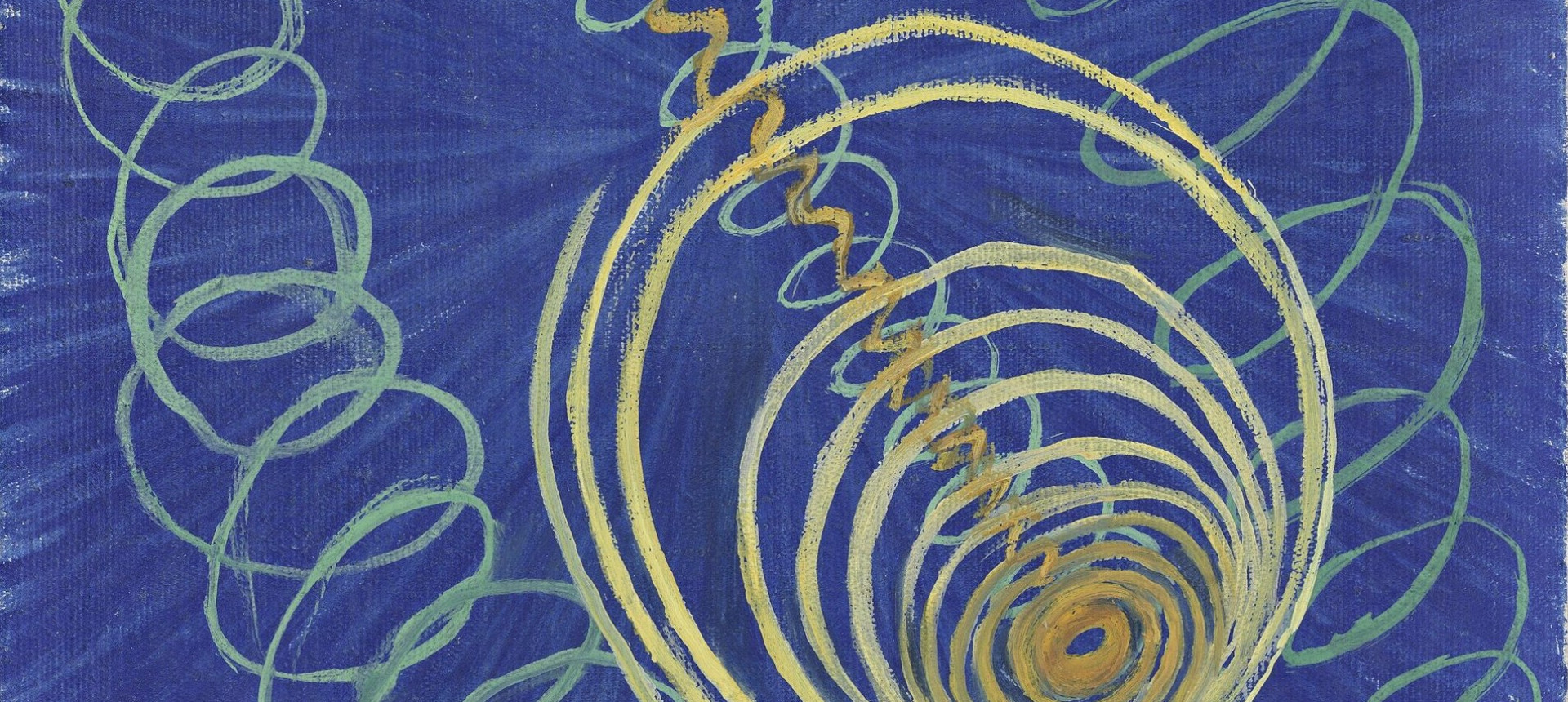
When the Gods Return: Psychedelics, Noetic Knowing, and the Mythic Unconscious
What often emerges during psychedelic states is a mode of knowing in which mythic contents are encountered as real. The gods, many of whose existence or names one may not even consciously know prior to the psychedelic encounter, cease to be symbolic ornaments of religion, and are instead experienced as living presences, as forces that act upon the psyche.
She encountered “a blue deity” at “the beginning of creation” for whom she had no name, no prior conscious knowledge of their existence, who was there to show her “to present the beginning”. During integration she realized she had encountered Vishnu, the divine source of all creation in the Hindu cosmology. (LSD experience)
Such experiences suggest an opening to what we might call the mythic unconscious. In this realm, the experience goes beyond mythos as story. This is mythos as a mode of revelation, a way in which a different reality is ensouled and its meaning is immediate and embodied. Experiences of this kind are often felt as revelations of reality. After his own experience with nitrous oxide, William James described mystical states as possessing a “noetic quality”: They are felt as disclosures of knowledge, carrying a peculiar authority. This noetic category is essential for understanding certain psychedelic states. In such experiences, one does not merely think that something might be meaningful; one knows it with immediacy.
The world erupted into creation, with colors and shapes I’ve never seen before. I was palpitating with life’s creation. This [event] was what we would later call ‘the Big Bang’’ (5-MeO-DMT experience)
The experience discloses a revelatory reality that feels more fundamental than rational modern Western consciousness ordinarily allows. As James wrote, our normal waking consciousness is “but one special type of consciousness”, while other forms lie close by, separated only by “the filmiest of screens” (James 1902, p 388). Psychedelic and other altered states of consciousness do not produce belief, but rather a felt knowledge, an experience of another order of reality breaking through the thin screen of ordinary consciousness. James addressed the phenomenology of these states, while Jung provided the framework for understanding their psychic reality.
For Jung “God is a psychic fact of immediate experience, otherwise there would never have been any talk of God ... It can be the most immediate and hence the most real of experiences” (Jung 1926, par 625). The gods exist as autonomous realities that seize, organize, and transform psychic life. The mythic unconscious is not a storehouse of inherited old stories of dead gods; it is a living stratum of the psyche in which archetypal powers retain their force. Archetypes “were, and still are, living psychic forces, that demand to be taken seriously” (Jung 1940, par 266). He also warned that “The gods have become diseases” (Jung 1929, par 54). The first formulation reminds us that archetypal realities are active at all times, while the second one warns us of what happens when a culture no longer has symbolic forms capable of mediating these active archetypal forces. The gods did not disappear because modernity ceased to believe in them; they returned in dissociated form within the modern unconscious. What was once encountered as gods reappears as symptoms. In the case of psychedelic experiences, the gods might return in their numinous force; psychedelic experience may confront the modern psyche with archetypal realities in their numinosities. Jung had already encountered the collective – the Red Book is the product and proof of such encounter. Asked whether he believed in God, Jung replied: “I know. I don’t need to believe. I know” (Freeman, 1959). Jung made a phenomenological distinction, akin to James’s noetic quality: Belief belongs to what is held at a distance, whereas knowing comes through the immediacy of an existential encounter. This noetic force is what makes such experiences both valuable and dangerous.
The Danger Lurking at the Doors of Perception
The same year Aldous Huxley published The Door of Perception (1954), Jung warned Father Victor White of this danger: “This is not the point at all, to know of or about the unconscious, nor does the story end here. On the contrary, it is how and where you begin the real quest. If you are too unconscious, it is a great relief to know a bit of the collective unconscious. But it soon becomes dangerous to know more, because one does not learn at the same time how to balance it through a conscious equivalent” (Jung 1976, p. 173).
The story does not end here. The uncovering of unconscious material is not the end goal. A “conscious equivalent” is needed, one that can contain the revelation and the newfound sense of knowing. Jung’s words of caution cannot not be underestimated. The modern mind requires a container, without which the effects can be dire. This is something that Albert Hofmann himself experienced during his first LSD experience:
A demon had invaded me, had taken possession of my body, mind and soul... I was seized by the dreadful fear of going insane. I was taken to another world, another place, another time. My body seemed to be without sensation, lifeless, strange. Was I dying? Was this the transition? (Hofmann, 2013, p. 20)
For the modern Western mind of Hofmann this was a profoundly frightening experience that was completely uncontained by the culture. This is why psychedelic experience is both precious and dangerous. It can reopen access to the mythic dimension of psyche, but it can do so with tremendous force, especially for those who are not properly prepared. In such states, the modern individual may discover that the world is not as disenchanted as assumed; that reality is more porous than secular rationalism advocates; that there are multiple, simultaneous realities; that the world of the living is but one emanation of this reality. Disclosure can overwhelm. Jung repeatedly emphasized the power of the numinous, and also stated that “the approach to the numinous is the real therapy” (Jung 1973, p 377). He never confused encounter with the difficult work of integration: Numinous experiences heal only when they are borne, reflected upon, and given symbolic form. How are such experiences to be contained?
The Psychoanalytic Temenos
Jung’s concern was that psychedelic experiences may grant unearned access to deep psychic material without the ego-strength and symbolic attitude necessary to assimilate them. The danger is not only of fragmentation or inflation, but the illusion that revelation is equivalent to growth. A person may glimpse the underworld and remain psychologically unchanged; one may be flooded with numinous imagery and still fail to enter into any genuine relation with it.
I was under the Earth, there was a dark figure, a skeleton with very little skin. He warned me: do not touch anything, or parts of you will be left behind, you’ll never be able to go back whole again. I later realized I had met Hades. (psilocybin experience)
Integration, in the Jungian sense, goes well beyond the afterglow of experience. It is the long labour by which what has been encountered becomes psychically real. As contributors such as Leslie Stein, Lionel Corbett, Susan Williams, Jerome Braun, Miriam Stein, Anne Flynn and Aurea Afonso Caetano, among others, have made increasingly clear, Jungians cannot afford to ignore the emerging field of psychedelics and psychedelic-assisted therapy. Analytical psychology is in a unique position to offer symbolic understanding, ethical containment, and clinically grounded forms of integration for these experiences.
A Jungian container does not explain the gods away, but neither does it surrender the ego to them. It provides, in Jung’s words “a conscious equivalent”. It offers the temenos in which imaginal experience can be held without reduction. It allows one to ask: What has been constellated? What symbolic task has been placed before me? How is this revelation to be related to my biography? Without such mediation, psychedelic discourse vacillates between two inadequate poles: a literalist spiritual inflation that is swallowed by the image, and a flattening neuroscientific reduction that downplays the reality of lived experience. This temenos must be an eloquent container that can encompass the magnitude of what is being revealed.
The Therapist’s Participation
In his 1954 letter to Victor White, Jung remarked regarding those who had laid hold of LSD “without the faintest knowledge or feeling of responsibility”, and he added that he can only hope “the doctors will feed themselves thoroughly with mescalin ... so that they learn for themselves its marvelous effect” (Jung 1976, p 173). This remark must be read as cautionary (and perhaps with a dose of irony). Its implications must be taken into serious consideration for those of us who are willing to explore this reality with others: Anyone who would undertake to mediate such states must themselves possess sufficient experiential knowledge. One cannot responsibly accompany another into these regions while remaining naive about the powers invoked.
The gods are not concepts; they are forces. And forces of that magnitude are above and beyond interpretation. They demand initiation into the burden of what one is trying to hold. To declare that “the gods are real” may be the most faithful description of what certain psychedelic experiences disclose. The mythic unconscious is not sealed off from reality and participates in depths modern Western consciousness has learned to ignore. When the gods return, the task is to help answer the call without being devoured by it.
References
Braun, J. (2023). Therapist’s experience with expanded states and psychedelic field: Perspectives rooted in Jungian psychology & Shipibo Indigenous healing traditions. In L. A. Stein & L. Corbett (Eds.), Psychedelics and individuation: Essays by Jungian analysts (pp. 141–156). Chiron Publications.
Caetano, A. A. (2023). Psychedelics: Another tool in analytical work? In L. A. Stein & L. Corbett (Eds.), Psychedelics and individuation: Essays by Jungian analysts (pp. 95–116). Chiron Publications.
Corbett, L. (2023). The therapeutic use of psychedelic agents: An overview. In L. A. Stein & L. Corbett (Eds.), Psychedelics and individuation: Essays by Jungian analysts (pp. 17– 40). Chiron Publications.
Freeman, J. (Interviewer), & Jung, C. G. (Interviewee). (1959, October 22). Face to face: Carl Gustav Jung [Television interview]. BBC.
Hofmann, A. (2013). LSD: My problem child (J. Ott, Trans.). Beckley Foundation Press; Oxford University Press.
James, W. (1902). The varieties of religious experience: A study in human nature; being the Gifford lectures on natural religion delivered at Edinburgh in 1901–1902. Longmans, Green, and Company.
Jung, C. G. (1926). Spirit and life. In H. Read, M. Fordham, G. Adler, & W. McGuire (Eds.), The structure and dynamics of the psyche. R. F. C. Hull, Trans., Vol. 8 (par 319–337). Princeton University Press.
Jung, C. G. (1929). Commentary on “The Secret of the Golden Flower.” In H. Read, M. Fordham, G. Adler, & W. McGuire (Eds.), Alchemical studies. R. F. C. Hull, Trans., Vol. 13 (par 1–56). Princeton University Press.
Jung, C. G. (1940). The psychology of the child archetype. In H. Read, M. Fordham, G. Adler, & W. McGuire (Eds.), The archetypes and the collective unconscious (R. F. C. Hull, Trans., Vol. 9i (par 151–181). Princeton University Press.
Jung, C. G. (1973). Letters of C. G. Jung: Vol. 1, 1906–1950 (G. Adler, in collaboration with A. Jaffé, Eds.; R. F. C. Hull, Trans.). Princeton University Press.
Jung, C. G. (1976). Letters of C. G. Jung: Vol. 2, 1951–1961 (G. Adler & A. Jaffé, Eds.; R. F. C. Hull, Trans.). Princeton University Press.
Stein, L. A. (2023). The self as the first principle for a psychedelic experience. In L. A. Stein & L. Corbett (Eds.), Psychedelics and individuation: Essays by Jungian analysts (pp. 231–252). Chiron Publications.
Stein, L. A. (2025, August 28). The place of psychedelics in Jungian analysis [Plenary presentation]. XXIII International Congress for Analytical Psychology, Zürich, Switzerland.
Stein, L. A., & Corbett, L. (Eds.). (2023). Psychedelics and individuation: Essays by Jungian analysts. Chiron Publications.
Stein, M., & Flynn, A. (2023). Integration of Jungian and psychedelic training and practice: A conversation. In L. A. Stein & L. Corbett (Eds.), Psychedelics and individuation: Essays by Jungian analysts (pp. 117–140). Chiron Publications.
Williams, S. (2023). Sharing in the field: The art of working energetically with psychedelics. In L. A. Stein & L. Corbett (Eds.), Psychedelics and individuation: Essays by Jungian analysts (pp. 337–358). Chiron Publications.